Classic Boating Is Without Doubt, The Most Affordable Way To Go Boating.

For the price of a well optioned Pontoon boat? And Steve Lapkin aint shoot’n no pontoon boat
I’ve been a boater my entire life. My grandfather taught me how to navigate, understand boats, and most importantly, how to love the sea. That love has only grown over time. So I can confidently say, from experience:
Classic boats are—hands down—the best, most fulfilling, and (wait for it)… affordable option out there.
WHAAAAT?!
“But what about all the maintenance? What about the other costs? Mechanics? Engines? All that stuff?”

Family sunset rides are not the same in plastic
Okay, let’s break it down:
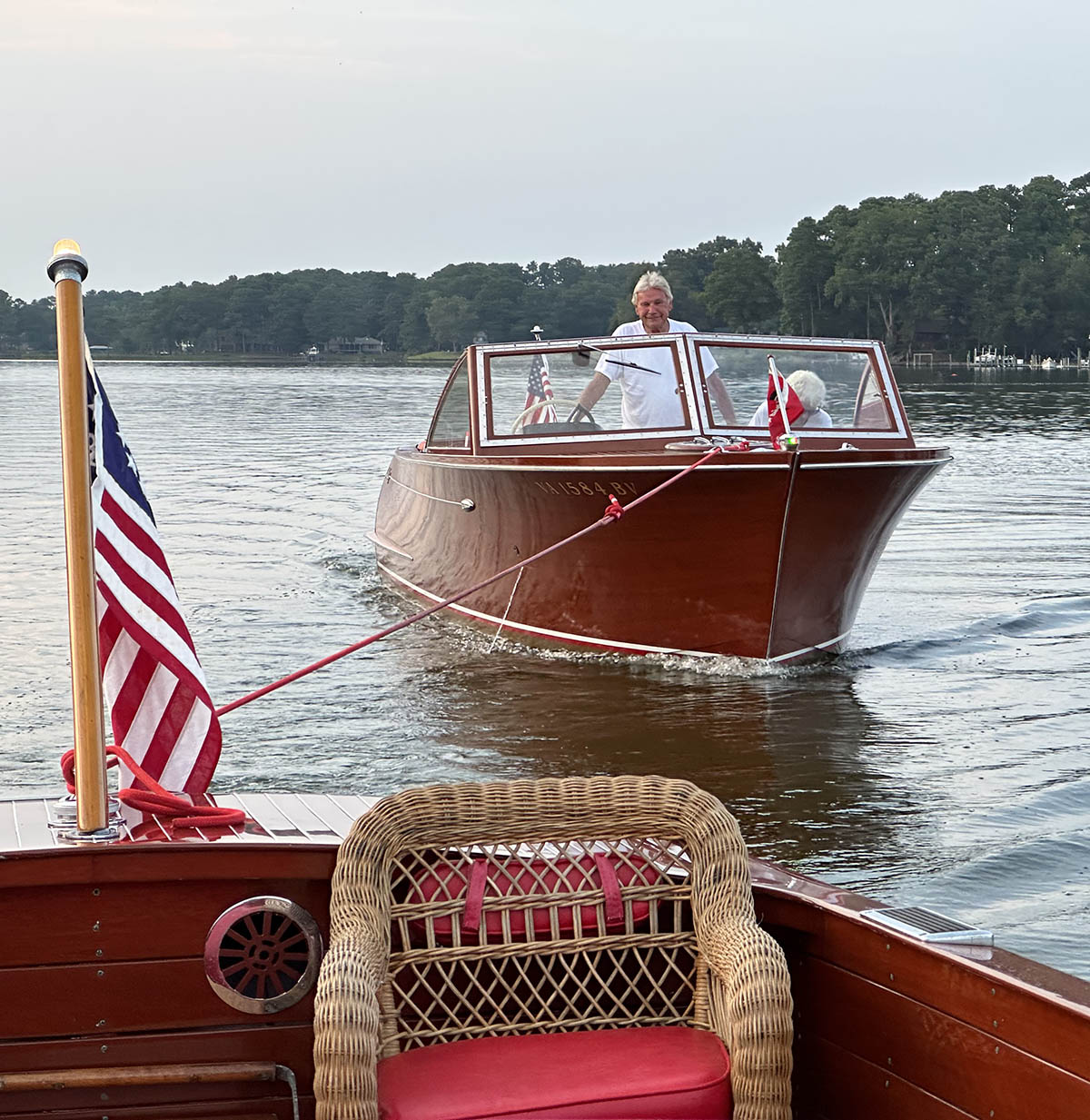
Really? I said break IT down, not break down
Okay for the sake of making this a short story. Attention span and all. I am generalizing. There are always extreme cases so shut up and enjoy.
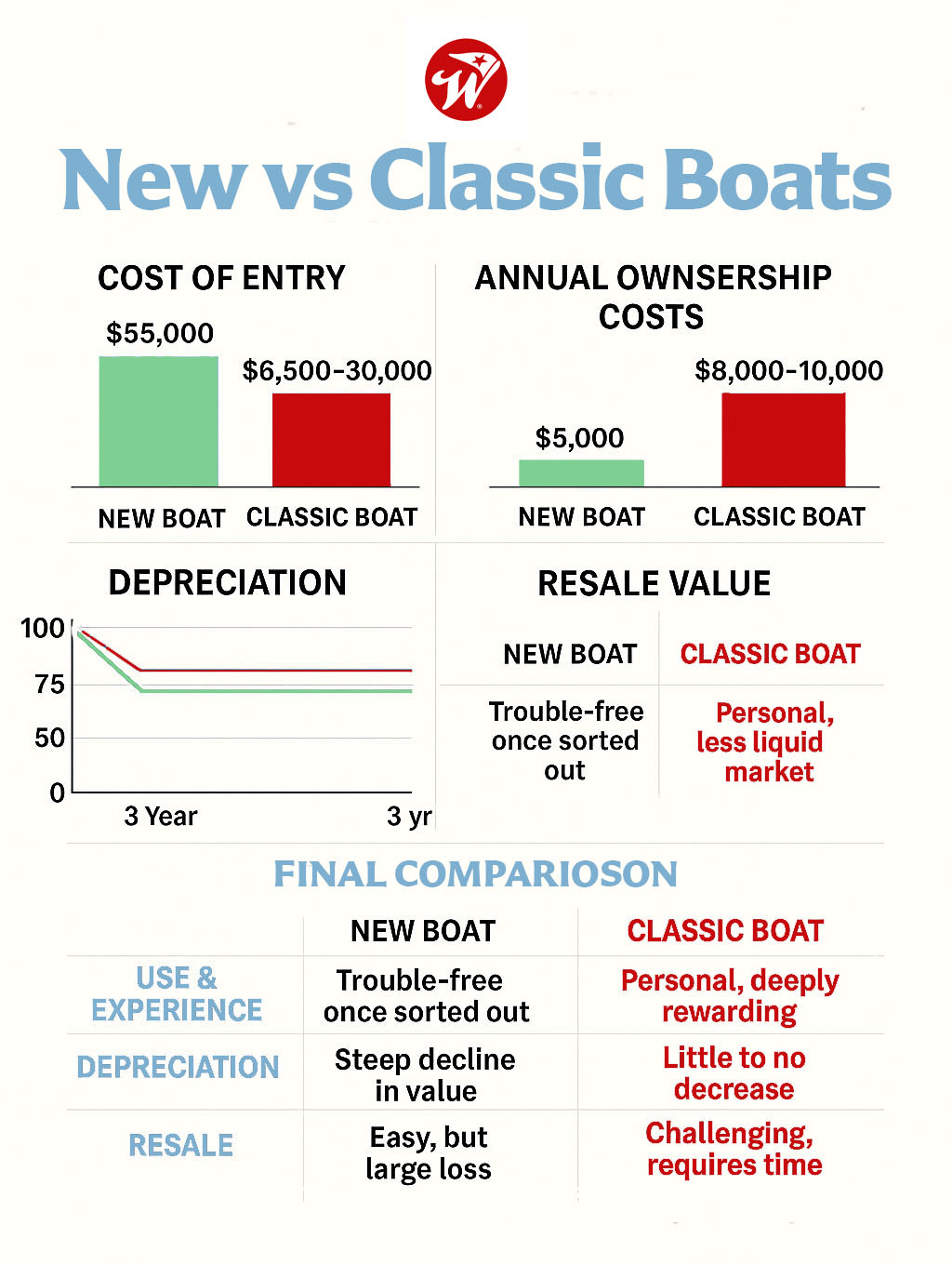
Cost of Entry
New Boat
Cheapest way in: ~$50,000
First-year additional costs (gear, taxes, break-in maintenance): ~$5,000
Total Year 1: $55,000
Classic Boat
Usable, restored example: ~$1,500–$20,000
First-year costs (repairs, upgrades, registration, etc.): ~$5,000–$10,000
Total Year 1: $6,500–$30,000

outta gas?
Cost of Ownership (Annual)
New Boat
Taxes, maintenance, insurance, storage, fuel: ~$5,000/year
Classic Boat
Taxes, maintenance, insurance, storage, fuel: ~$8,000–$10,000/year
(Yes, slightly higher—but more flexible depending on DIY involvement and usage.)
Depreciation
New Boat
~20% value drop in Year 1
~5% every year after
(A $50K boat might be worth ~$25K in 5 years.)
Classic Boat
Little to no depreciation if properly maintained
May gain value over time if restored or upgraded well
(Some classics are appreciating assets.)
Use & Experience
New Boat
Generally trouble-free—once warranty bugs and sensors are sorted
Plug-and-play confidence; just go and enjoy

Viseral
Classic Boat
A more visceral, personal experience
You are the computer and the sensor
Requires involvement and understanding—but that’s the beauty of it
When dialed in, can be remarkably reliable—and incredibly satisfying
Resale
New Boat (Now Used)
Dealers offer wholesale prices based on a saturated, well-defined market
Expect to recoup ~50% of your total expense
Classic Boat
Smaller, less liquid market
Wholesale buyers exist, but for the best return, you’ll need time, knowledge, and the right buyer
That said—yes, selling your classic is absolutely possible
Final Thoughts
Classic boats aren’t for everyone—but for those who “get it,” the connection is unmatched. You’re not just buying a boat, you’re adopting a legacy. And in the end, that’s what makes classic boat ownership more than just affordable—it makes it priceless.




Nice analysis but you forget a comparison of the sound. Most new boats sound like sewing machines. But the sound of an inboard classic at idle or under load is music! Just saying.
If you buy it right, and do all your own work, wood boats offer real value over glass. And working with wood is way more pleasant and satisfying.
It all looks great and understandable to those of us who have reached a more mature [?] status but!! I just got back from a wedding of one on my daughters’ closest friends and had great conversations with the young people, late 20’s and early 30’s, college grads and hardworking, who all lament about the struggle to be able to buy a decent house at this time in their lives. When you add in the anticipated cost of raising children the thought of having any kind of boat is way down the list. In regard to getting young people in the hobby I think we need to be patient and remember that at that age we didn’t have a “pot to piss in” either but here we are.
You are comparing new vs used (AKA: classic). Used will always win when figuring depreciation of new.
It would be interesting to try and compare “Classic Wood” VS “Classic Glass”. Even though they both need time, skills, and lots of elbow grease, I suspect that “Classic Glass” would win on a strictly financial analysis.
It was GREAT to hear Hank’s perspective yesterday. I still feel that youth in this hobby means late 40’s or early 50’s. Looking for much younger than that is crazy in my opinion. Yes, I know there are some out there, but they are few and far between. KNOW YOUR AUDIANCE.
I agree. I got into wood boating and bought my wooden boat after my boys all graduated college, we were empty nesters, which was my mid 50’s. That’s when it made the most sense. “Our Time”.
“for those that get it” that says it all. If you get it, the cost argument makes sense – to a degree I do dispute some of your numbers. But, where is the small boat market? Go to a major boat show like The Annapolis Power Boat Show. What do you see? Center console & wake board boats. The balance are 70 mph+ and runabouts of various forms. The only place classic boats can compete against are the runabouts.
I have a Kavalk Classic 19 which I describe as a crossover boat. Glass hull mahogany interior and deck. My neighbor has a bow rider runabout. Nice design. My boat is in a boat house with closed sides on a lift, a rarity in Virginia (I wouldn’t own it if I didn’t have the boat house) his is on a lift. He regularly comments on the amount of time I spend keeping the Kavalk in shape. He thinks it is a beautiful boat but has no interest in owning it. I also have the professional skill set to keep it up. My guess is he is 20 years younger. I grew up with mahogany and teak and spring outfitting rituals. This is an uphill battel to get people interested that, in many cases are not sure what a screw driver is. Blame the demise of shop class in our schools, which itself is a major societal problem.
The Chesapeake Bay chapter is trying something very unique and not easy to accomplish, at the St Michaels show. On Sunday they are setting up a display of unrestored boats vs. similar boats that have been restored to highlight the process, provide info, etc. It will be interesting to see how that works out.
One of our members, who is now “hooked” on the wooden boat adventure, said going down below in his fiberglass sailboat was like crawling into a Clorox bottle. That about sums it up!
My cabin is in NW Wisconsin, about 70 miles from Minneapolis. Here’s the state of new boating in my neck of the woods.
I would argue that $50k for a new boat is way on the low side. Here 3 out of 4 cabins have a pontoon at the dock. They may be ugly, but for most people on a 2,000 acre lake with no “big water” that comfortable moving patio that can fit twelve or more of your friends is the perfect solution. What baffles me is how common 250 hp (and up) outboards have become on new luxury pontoons. Those are $100k plus boats. And they’re everywhere. Going fast in those things is just pointless. And you don’t need 250 hp to pull a tube.
The second most common new class of boats are wake boats. They create their own kind of hell with the shore erosion and the blaring sound systems. But those are $150k and up all day long. Most are going over $200k at our local marina.
The bass boats on the lake are mostly trailered in: It’s a great bass lake but those serious anglers want the ability to go where the fish are. (They’re a rare sight on a lift.)
A humble new fiberglass runabout with a smaller outboard? Practically extinct.
But when I pull up at the docks in my little Gar Wood Ensign (that I paid less than $30k for, fully restored) everyone ignores the $150k toons and the $200k wake boats. But it’s not about turning heads. Rabbit gives us so much joy: We use it so much.
(Full disclosure: We own a 20 year old Hurricane deck boat that I paid $12k for 18 years ago. Fiberglass deep V hull and I/O power with a pontoon top. It serves as our patio at the dock and the way to take twelve people on the lake. I keep it on perfect condition. Someday I’d love to replace it with a big comfortable lap strake. But, again, it cost $12k.)
There’s a restaurant with an outside deck located on a channel connecting two of our lakes. I’ve seen $200k+ Nautiques and new fully dressed Tri-Toons with 400hp Mercs idle by and no one seems to look up from their diner and cocktails. ‘Ho-hum’ is their attitude. Then Jan and I idle by in our ’63 Coronado with its low rumble and everyone on the deck stops what they’re doing and stares at us as we glide past. Most smile, wave, or give us the thumbs up. Looks of envy and ‘wow’ are broadcasted on their faces. All for a lot less than those other new watercraft. How do you put a price on that? There’s just a ‘cool’ factor in our classics that new ski-boats and tri-toons will never match. That’s what I call lifestyle value.
Two factors that I have experienced. I had an appliance parts store. For years I helped the do your self folks to keep them from buying parts that wouldn’t fix the problem. By the time I retired the mechanical ability of individuals had declined. Their source of tools was the wife’s junk drawer.
Second, the ability for young adults to afford to purchase a home has become nearly impossible. The classic wood boat isn’t even a consideration!
If one just wants to get on the water a fiberglass or aluminum well taken care of outboard garage baby could be affordable for the young. My best boating was a ten horse Johnson on a Chris Craft kit boat! The comments about Tupperware boats could be offensive which doesn’t help attracting people to the antique woody boat culture. I personally have neither the time nor money for a mahogany showpiece but I certainly appreciate the work and artistry of them. Mat’s daily efforts are also a gift! Max.
Read em all…can’t add anything but agreement with Troy, Gary, and Max….John in Va….
“Generally trouble-free—once warranty bugs and sensors are sorted
Plug-and-play confidence; just go and enjoy”
This is more marketing pitch than reality. New boats break during and after warranty coverage just like old boats.
I agree with most above comments. We have left out one major component. Used newer boats. For about 1/2 the price of a new boat, young people can enjoy a late model low hours boat. so let’s look at it this way. Do they want to spend Saturday boating, or sanding? Thats a no brainer for a person who has worked 40+ hours all week. Let the young people love the water first. Show them our beautiful wood boats. As time and money become more accessible, they will come over to our side. However they may be 40 to 60 years old. Thats young to me.
Another perspective here. Living on the western shore of Lake Michigan, I’ve plenty of access to miles of rivers. Lots of boats here too, but these are the deepwater vessels rigged to slay those lake salmon. Don’t get me wrong! Charters are the life blood of these small communities. However, there is the mindset of “Why be on the water if you’re not filling your freezer?” I don’t perceive an open sense of hostility towards recreational boaters, but maybe a sense of puzzlement? In that regard, I welcome the sight of pontoons. Bringing folks together on the water is the whole point, at least in my humble opinion.
Great comments!
I need your chart to display at our BIG Seattle Boat show…